Stop guessing on the job. Wire, size and troubleshoot a U.S. home the way the inspector expects to see it.
3 complete books based on the NEC®, 56 technical plates and 4 job tools: the 120/240V system, every component and the full method to size each conductor, worked out on real equipment.
U.S. Residential Electrical Series: 3 Books + 56 Technical Plates + 4 Job Tools | Based on the NEC® + 7 Free Bonuses
- The 3 books of the series
$67INCLUDED




🎁 Free bonuses included
On top of the 3 books, you get these 7 extras at no cost
These bonuses are worth $69 FREE
What you'll be able to handle
Real situations from a U.S. residential job that the series walks you through, from where a receptacle can go to which breaker a circuit needs.

Put every device where code allows
Heights, spacing, prohibited zones and room-by-room placement tables for receptacles, switches and fixtures.

Know which protection goes where
GFCI vs. AFCI vs. breaker, where each one is required and how to troubleshoot a nuisance trip.
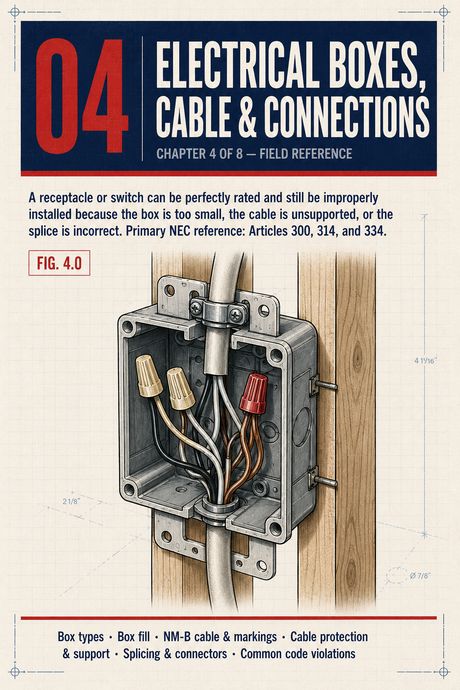
Get boxes and connections right
Box fill, cable types and how each conductor lands, so nothing comes back as a callback two years later.

Match the breaker to the circuit
Ratings, single and double pole, tandem breakers and why the breaker always follows the wire, not the other way around.
And much more inside the 3 books and the 7 bonuses
What's inside?
Three books built to be read in order: fundamentals first, a field reference for every component, then the method to size every conductor
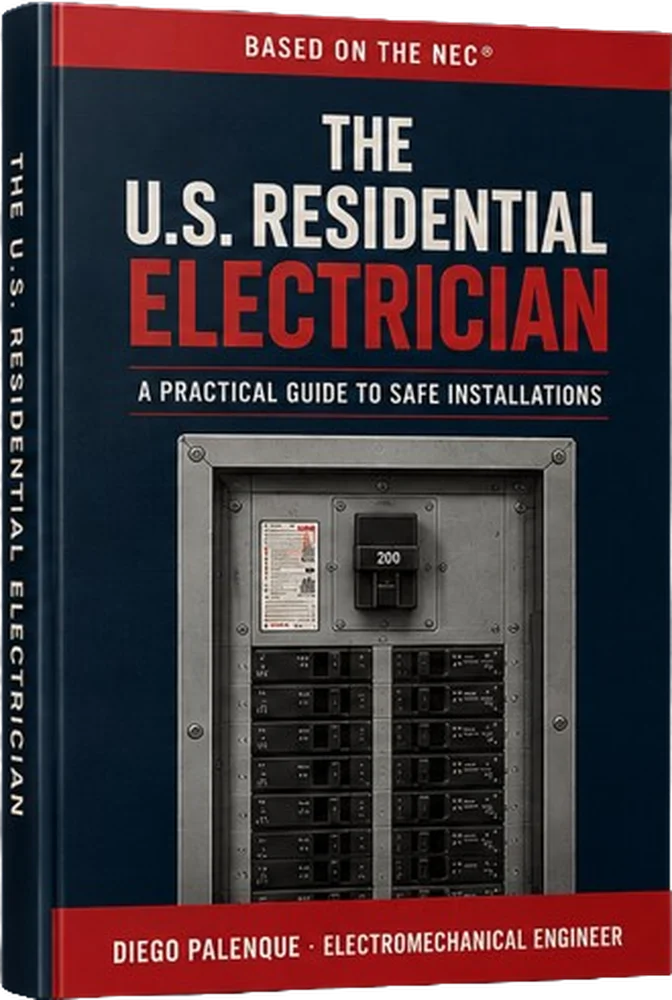
The U.S. Residential Electrician
From what electricity actually is to how a complete home is wired, utility to last branch circuit.
- Voltage, current, resistance and power
- The 120/240V split-phase system
- Service equipment and panelboards
- Field safety + Quick Reference
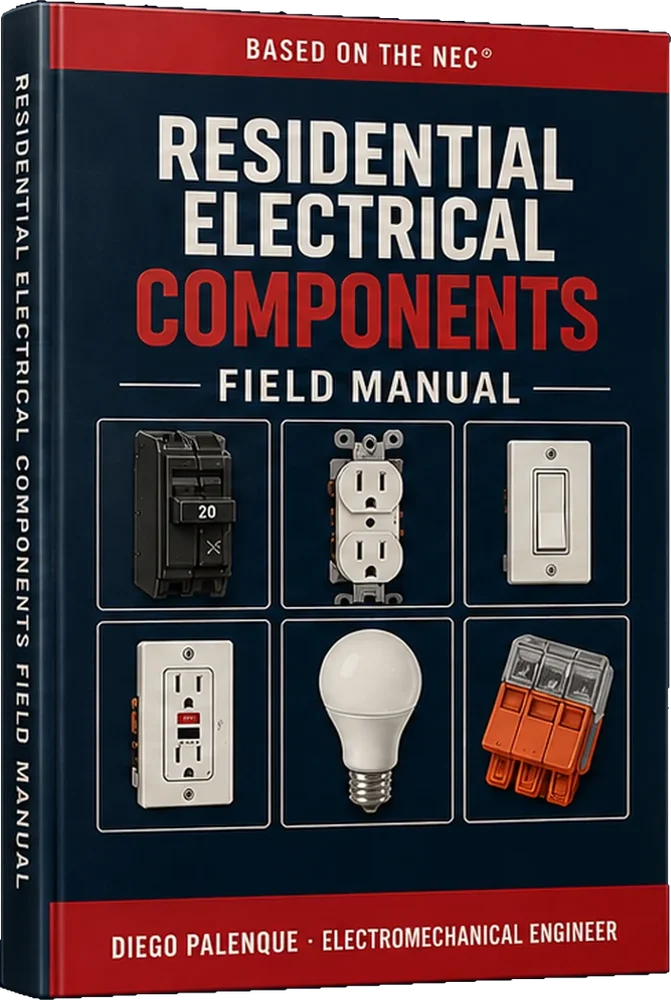
Components Field Manual
The one you keep open on the job: what each device needs and exactly where it belongs.
- Parts diagrams for every major component
- Heights, spacing and prohibited zones
- Room-by-room placement tables
- Common code violations to avoid
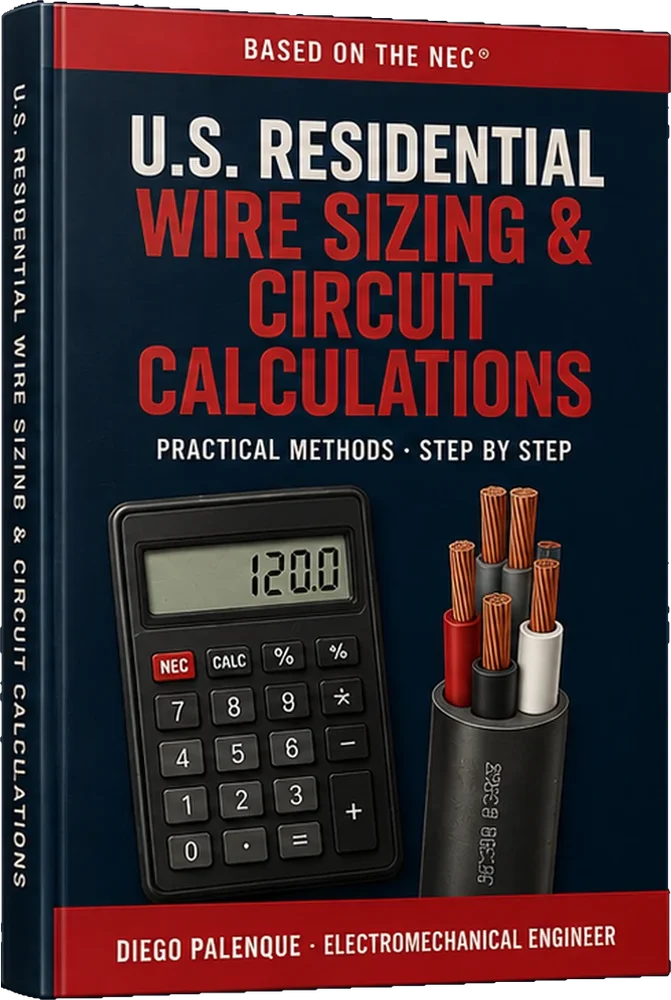
Wire Sizing & Circuit Calculations
The complete conductor-selection method, applied to 12 real residential projects.
- Step-by-step conductor selection
- Water heater, range, mini-split, EV charger
- Ampacity, MCA/MOCP and voltage drop
- The most common sizing mistakes
Worked out on real equipment
Every calculation is done in full on an actual appliance with its nameplate, so you follow a method you can repeat instead of memorizing a chart.
Technical plates that show it
Full-page plates with labelled parts and the code articles that govern them. Black hot, white grounded, green ground, exactly as you'll find them in the wall.
Written for the U.S. system
Not translated from another country. The terminology is the one you hear on a U.S. jobsite: grounded conductor, branch circuit, feeder, service equipment.
Tools you use on the job
Wire size calculator, load worksheet, placement checklist and a project log, so the method goes with you from the book to the jobsite.
Your work, before and after the series
It's not about being smarter or memorizing more. It's having the U.S. method in one place and knowing why each rule exists.
 Before
Learning from scattered videos
- Guides written for another country's voltage and code
- You pick the wire size from a chart without knowing why
- You're never sure if a box location will pass
- Callbacks from splices and terminations that looked fine
 After
AfterWorking with the U.S. method
- One reference for the 120/240V system you actually work on
- You size each conductor step by step and can defend it
- Placement tables tell you where every device can go
- Splices and terminations done right the first time
Sound familiar?
If any of these is you, this series was written for you
You know the work, but not the U.S. words for it
The inspector, the supplier and the plan all use different terms. Every concept here is defined the first time it appears, the way it's said on a U.S. jobsite.
You size wire from a chart and hope it's right
Book 3 gives you the full method with ampacity, MCA, MOCP and voltage drop, worked out on 12 real appliances.
You're not sure where a device is allowed
Book 2 puts heights, spacing and prohibited zones for every component in one place, room by room.
Everything you find online is from another system
Different voltage, different code, different vocabulary. This series was written in English for the U.S. from page one.
If you said "yes" to any of these, the series fixes it.
Reviews from our readers
What readers say about the series
Everything included in your purchase
Instant access to all of this for a single payment
- U.S. Residential Electrical Series: 3 Books + 7 Free Bonuses$16.99
7-day money-back guarantee · 100% secure checkout
How to use the series on a real job
Three simple steps
Find the task
Look up the device, circuit or appliance you're working on. Each topic takes one or two pages, with its plate.
Follow the worked example
Read the explanation, check the plate and follow the example step by step. The calculator confirms your numbers.
Check it before inspection
Run the placement checklist and log the nameplate data, so the job matches what the inspector expects to see.
GUARANTEE
Read it. If it doesn't help, get your money back.
Download the three books, read them, use them on a real job. If they don't give you something you didn't have before, request a refund within 7 days and you get your money back in full. No forms, no explanations.
🛡️ 7 days of buyer protectionFrequently asked questions
Everything you need to know before you buy
Stop learning from guides written for another country. Get the U.S. method in one place, today.
Includes 7 free bonuses
You save $119
This series presents general residential electrical principles for educational purposes. It does not replace the National Electrical Code (NEC), local amendments, OSHA requirements, or the guidance of your Authority Having Jurisdiction (AHJ). Always verify installations against the code edition adopted in your jurisdiction.
WAIT!
Before you go...

Take the complete series with an extra discount if you buy now:

2 minutes ago